



Duke’s Story
A bouncy St Bernard to our Gorgeous Wobbly Boy
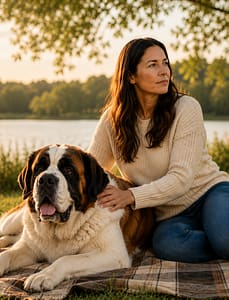
Like many other stories, the day Duke had a spinal stroke was one of the most frightening days we’ve ever experienced as pet owners.
Duke was his normal bouncy self, then suddenly he was struggling to stand. One side of his body seemed weak, and he couldn’t coordinate his movements. Luckily we were home and could take him to the vet straight away. That’s when we first heard about Fibrocartilaginous Embolism (still can’t pronounce it) or spinal stroke in dogs.
The diagnosis came with a lot of uncertainty, and the vet couldn’t tell us exactly what the future would look like. We were told to prepare for a long rehabilitation journey.
In the early days, one of the biggest challenges was Duke couldn’t urinate on his own. We found ourselves learning skills we never imagined we’d need. Bladder expression became part of our daily routine and Duke is a big boy, so this was no easy feat. With physiotherapy exercises, medications, and helping him move around safely, the journey was hard.
It was so emotional. We worried constantly. Were we doing enough? Was he improving? Would he ever walk normally again? Some nights felt endless as we checked on him, adjusted his bedding, and tried to keep him comfortable. Honestly, with Duke’s size it was so very difficult to help Duke through such an ordeal.
Our home changed almost overnight. Non-slip mats appeared throughout the house, furniture was rearranged to create safe walking paths, and a support harness became one of our most important tools. Every day revolved around helping Duke recover.
Progress came slowly.
For weeks, improvements were almost impossible to see. Then one day we noticed a slight movement in his affected leg. It was only a small twitch, but it felt enormous. That tiny sign gave us hope and renewed determination to keep going.
Over the following weeks, we celebrated every milestone. A stronger step. Better balance. A little more confidence. Things that would have seemed insignificant before suddenly became major victories.
One of the most memorable moments of Duke’s recovery came when he was finally able to pee by himself again. After weeks of managing his bladder, it felt like a huge breakthrough. The weeks had certainly taken their toll on our own backs as well, as I am sure you can imagine. We probably celebrated more than most people would understand, but anyone who has cared for a dog with FCE knows exactly how important those moments are.
Duke’s condition is improving.
Today, Duke has come a long way. He can move around the house independently, enjoys spending time outside, and once again greets us at the door with a wagging tail. His personality never disappeared, even during the toughest days, and seeing his confidence return has been incredibly rewarding.
He still has a limp on one side, particularly when he’s tired or after a longer walk. We don’t know if that limp will ever completely disappear, and honestly, that’s okay. Compared to where we started, it’s a small reminder of how far he’s come.
Slow and steady Recovery
Duke’s spinal stroke journey taught us patience, resilience, and the importance of celebrating small victories. Looking back, the journey wasn’t easy, but watching our wobbly boy regain his independence step by step has been one of the most rewarding experiences of our lives. Every slightly wobbly step is proof that recovery is possible, and every day we’re grateful for the progress he’s made.
Flynn’s FCE Story
Flynn’s FCE StoryOur very own story of Flynn ~ FCEtalk Chief FCE…

Duke’s Story
Duke’s StoryA bouncy St Bernard to our Gorgeous Wobbly Boy Like many…

Learn More About FCE
At FCE talk, we explore everything you need to know about Fibrocartilaginous Embolism (FCE) in dogs,
including symptoms, diagnosis, treatment, and recovery.
Download your free FCE guide today
Download your free FCE guide today and feel less alone, with gentle guidance, real experiences, and supportive steps to help your pet recover with hope, confidence, and love each day