



What Is Canine Spinal Stroke?
Clear answers about FCE, helping you understand your dog’s sudden paralysis.
A note about our site:
Where possible, FCEtalk uses minimal images for easier printing
helping you create clear, practical reference guides to support your pet’s recovery journey.

What Is Fibrocartilaginous Embolism (FCE)
When your dog suddenly collapses or loses the ability to use one or more legs, it is one of the most frightening experiences any owner can face. One minute they are playing or simply walking across the yard. The next, they are unable to stand.
For many families, the diagnosis is Fibrocartilaginous Embolism (FCE)—often called a spinal stroke.
Understanding Fibrocartilaginous Embolism (FCE), why it happens so suddenly, and what it means for your dog’s recovery.
Although the word stroke sounds alarming, an FCE is very different from the strokes that affect people. Rather than involving the brain, an FCE affects the spinal cord, disrupting the nerve signals that allow your dog’s body to move normally.
The good news is that many dogs improve significantly after an FCE. Some regain almost normal function, while others learn to live happy, fulfilling lives with only minor limitations. Recovery depends on the severity of the injury, the area of the spinal cord affected and the rehabilitation provided during the weeks and months that follow.
Understanding what has happened is often the first step towards replacing fear with confidence. In this guide, we’ll explain exactly what an FCE is, why it occurs so suddenly, whether it’s painful, and what you can realistically expect moving forward.
What Is a Spinal Stroke (FCE) in Dogs?
Understanding Fibrocartilaginous Embolism (FCE), why it happens so suddenly, and what it means for your dog’s recovery.
When your dog suddenly collapses or loses the ability to use one or more legs, it is one of the most frightening experiences any owner can face. One minute they are running, playing or simply walking across the yard. The next, they are unable to stand.
For many families, the diagnosis is Fibrocartilaginous Embolism (FCE)—often called a spinal stroke.
Although the word stroke sounds alarming, an FCE is very different from the strokes that affect people. Rather than involving the brain, an FCE affects the spinal cord, disrupting the nerve signals that allow your dog’s body to move normally.
The good news is that many dogs improve significantly after an FCE. Some regain almost normal function, while others learn to live happy, fulfilling lives with only minor limitations. Recovery depends on the severity of the injury, the area of the spinal cord affected and the rehabilitation provided during the weeks and months that follow.
Understanding what has happened is often the first step towards replacing fear with confidence. In this guide, we’ll explain exactly what an FCE is, why it occurs so suddenly, whether it’s painful, and what you can realistically expect moving forward.
What Is a Spinal Stroke (Fibrocartilaginous Embolism)?
A Fibrocartilaginous Embolism (FCE) occurs when a tiny fragment of material from one of the spinal discs enters a blood vessel supplying the spinal cord.
This small piece of fibrocartilage travels through the bloodstream until it blocks one of these vessels. Once blood flow is interrupted, the affected section of the spinal cord no longer receives enough oxygen and nutrients.
Without an adequate blood supply, the nerve tissue begins to malfunction almost immediately. This interruption prevents nerve messages travelling between the brain and the rest of the body, leading to sudden weakness or paralysis.
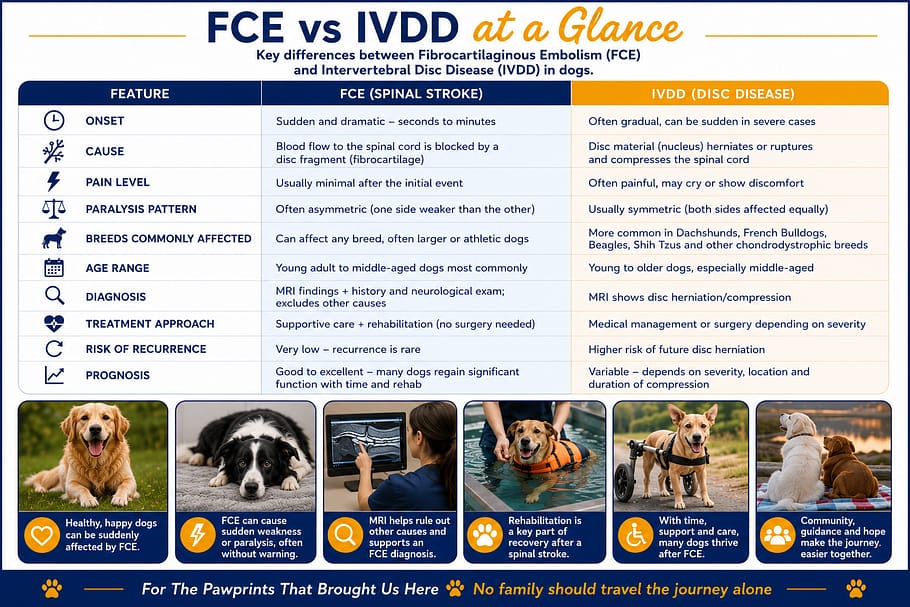
Unlike conditions that compress the spinal cord, such as Intervertebral Disc Disease (IVDD), an FCE does not usually involve ongoing pressure on the spinal cord. Instead, the damage results from a brief interruption in circulation—much like a heart attack affects heart muscle or a stroke affects brain tissue.
The severity of symptoms depends entirely on:
- The size of the affected blood vessel
- The location within the spinal cord
- How much nerve tissue loses blood supply
- Whether one or both sides of the spinal cord are affected
Because every spinal cord contains millions of nerve fibres responsible for movement, sensation, bladder control and coordination, the signs of FCE can vary considerably from dog to dog.
What Actually Happens Inside the Spinal Cord?
To understand an FCE, it helps to picture the spinal cord as a highly sophisticated communication highway.
Your dog’s brain constantly sends electrical messages down the spinal cord. These signals tell the muscles when to move, maintain balance, coordinate walking, wag the tail and even control bladder and bowel function.
At the same time, sensory nerves send information back to the brain, allowing your dog to feel where their feet are, detect touch and respond to changes in the environment.
These delicate nerve cells require a constant supply of oxygen-rich blood.
During an FCE:
- A tiny fragment of disc material enters a blood vessel.
- The fragment blocks circulation.
- Blood flow stops to part of the spinal cord.
- Nerve cells become deprived of oxygen.
- Normal communication between the brain and body is interrupted.
Think of it like a major highway where traffic suddenly comes to a complete stop because of a roadblock. The vehicles behind the blockage can’t continue their journey, even though the road itself remains intact.
Similarly, your dog’s muscles may be perfectly healthy—but without messages reaching them from the brain, they cannot function normally.
The encouraging news is that many nerve pathways surrounding the damaged area remain healthy. Over time, the nervous system can often adapt, allowing neighbouring pathways to compensate for injured ones through rehabilitation and repeated movement.
This remarkable ability is known as neuroplasticity, and it forms the foundation of recovery for many dogs with FCE.
Causes of FCE
One of the most frustrating aspects of FCE is that there is usually nothing an owner could have done to prevent it.
Despite decades of veterinary research, the exact cause remains uncertain.
Veterinary specialists believe that a small amount of fibrocartilage from an intervertebral disc somehow enters a nearby blood vessel during a sudden movement or increase in pressure.
Potential triggers may include:
- Running at high speed
- Jumping from furniture
- Playing vigorously
- Twisting suddenly
- Landing awkwardly
- Normal everyday activity
However, many dogs experience an FCE while doing nothing unusual at all.
Some simply stand up after resting.
Others are walking quietly across the room.
Some are found lying in the backyard unable to stand.
This unpredictability is one reason FCE can feel so devastating.
Importantly, owners should not blame themselves. There is currently no evidence that diet, exercise, supplements or routine care directly cause an FCE.
Which Dogs Are Most at Risk?
An FCE can affect almost any breed.
Although larger dogs appear more commonly represented, spinal strokes have been diagnosed in dogs ranging from tiny toy breeds to giant working dogs.
Breeds frequently reported include:
- Labrador Retrievers
- Border Collies
- German Shepherds
- Golden Retrievers
- Australian Shepherds
- Staffordshire Bull Terriers
- Mixed breeds
Most cases occur in young adult to middle-aged dogs, although both younger and older dogs can develop the condition.
Why It Happens So Suddenly
One of the defining features of FCE is its incredibly rapid onset.
Unlike arthritis, degenerative disease or slowly progressing spinal disorders, an FCE develops within minutes.
Owners often describe stories such as:
“He was chasing a ball and suddenly cried out.”
“She finished her walk and couldn’t stand.”
“Everything changed in less than five minutes.”
Once the blood vessel becomes blocked, the affected spinal cord tissue immediately loses its oxygen supply.
Nerve cells stop functioning almost instantly, leading to sudden weakness or paralysis.
Most dogs reach their worst neurological state within the first 12 to 24 hours.
Unlike many spinal conditions, FCE usually does not continue getting worse for days.
Once the blood supply interruption has occurred, the injury generally stabilises, allowing recovery to begin.
This is an important distinction because many owners fear the paralysis will continue spreading indefinitely.
Fortunately, that is not usually how FCE behaves.
Is It Painful?
This is one of the questions owners ask most often.
The answer is both yes and no.
Initial pain
Many dogs experience a brief yelp or cry when the spinal stroke first occurs.
This likely reflects the sudden event happening within the spinal cord.
After the event
Once the spinal injury has stabilised, most dogs are not experiencing ongoing severe pain from the FCE itself.
Instead, they are dealing with:
- Weakness
- Loss of coordination
- Paralysis
- Balance problems
- Reduced sensation
This is one reason veterinary neurologists often consider FCE less painful than conditions such as IVDD, where ongoing disc compression can continue causing discomfort.
That said, every dog is different.
Some dogs may develop:
- Muscle soreness
- Joint stiffness
- Pressure sores
- Secondary injuries
- Anxiety associated with reduced mobility
These issues should always be discussed with your veterinarian.
Can It Happen Again?
The reassuring answer is that recurrence is considered very uncommon.
Unlike degenerative spinal diseases, an FCE is generally regarded as a one-time event.
Most dogs never experience another spinal stroke.
While isolated reports of recurrent FCE exist in veterinary literature, they are rare.
This means that once your dog has recovered, you can usually look toward the future with confidence rather than constantly worrying another episode is just around the corner.
Of course, every dog can still develop unrelated spinal or neurological conditions later in life, but these should not automatically be assumed to be another FCE. Any sudden weakness should always be assessed promptly by a veterinarian.
Common Symptoms of FCE
Symptoms vary depending on which section of the spinal cord is affected.
Common signs include:
- Sudden collapse
- Weakness in one or more legs
- Dragging paws
- Knuckling of the feet
- Difficulty standing
- Loss of coordination
- Uneven paralysis affecting one side more than the other
- Loss of bladder control
- Reduced tail movement
- Difficulty walking
One characteristic feature is asymmetry. Many dogs are significantly weaker on one side than the other.
This asymmetrical presentation often helps veterinarians distinguish FCE from other spinal diseases.
How Veterinarians Diagnose FCE
Unfortunately, there is no single blood test that confirms an FCE.
Instead, diagnosis combines:
- Medical history
- Physical examination
- Neurological examination
- Blood tests
- X-rays
- Advanced imaging
An MRI is currently considered the most useful imaging tool because it allows specialists to evaluate the spinal cord itself while ruling out conditions such as disc herniation, fractures and spinal tumours.
Sometimes the MRI findings are classic for FCE.
Other times, the diagnosis is made by combining imaging with your dog’s history and neurological signs.
Treatment and Supportive Care
There is currently no medication that can reverse an FCE.
Instead, treatment focuses on giving the nervous system the best opportunity to heal.
Supportive care may include:
- Hospitalisation
- Intravenous fluids if needed
- Bladder management
- Assistance with toileting
- Pain management where appropriate
- Pressure sore prevention
- Good nutrition
- Physical rehabilitation
Early rehabilitation has become one of the most important components of recovery.
Depending on your dog’s condition, this may include:
- Assisted standing
- Passive range-of-motion exercises
- Weight shifting
- Balance work
- Controlled walking
- Hydrotherapy
- Cavaletti exercises
- Strength training
Every rehabilitation plan should be tailored to the individual dog.
Recovery After an FCE
Recovery often surprises owners.
The first few days can feel overwhelming, yet many dogs begin showing small improvements sooner than expected.
These improvements may include:
- Tail movement
- Improved bladder control
- Toe movement
- Standing briefly
- Taking assisted steps
- Increased strength
Recovery continues over weeks and months.
While every case differs, many dogs make their greatest gains during the first three to six months, although improvements can continue well beyond this period.
Patience is essential.
Progress is rarely linear.
Some weeks feel dramatic.
Others seem to stall completely.
Small gains accumulate over time.
Living with a Dog After an FCE
Even dogs left with permanent weakness can enjoy wonderful quality of life.
Many continue to:
- Go on walks
- Swim
- Play with toys
- Travel
- Enjoy family outings
- Use mobility aids successfully
Dogs are remarkably adaptable.
Unlike people, they rarely dwell on what they have lost.
Instead, they simply learn new ways of moving through the world.
Owners often discover that their dog’s enthusiasm for life returns long before their physical recovery is complete.
Frequently Asked Questions
Is FCE a true stroke?
Not in the same way as strokes affecting the brain. An FCE is commonly called a spinal stroke because it interrupts blood flow to part of the spinal cord rather than the brain.
Does every dog recover?
No. Recovery varies according to the severity and location of the spinal cord injury. However, many dogs regain excellent mobility with time and rehabilitation.
How long does recovery take?
Some improvements may appear within days, but meaningful recovery often continues for several months. Every dog follows their own unique timeline.
Can my dog walk again?
Many dogs do walk again, even if they initially appear completely paralysed. Early rehabilitation and supportive nursing care can significantly improve functional outcomes.
Should my dog exercise after an FCE?
Exercise should always be guided by your veterinarian or rehabilitation professional. Carefully planned rehabilitation is usually beneficial, while excessive or inappropriate activity may slow recovery.
Key Takeaways
An FCE is one of the most frightening diagnoses a dog owner can receive, largely because it happens without warning. Yet despite its dramatic onset, it is also one of the neurological conditions that often carries genuine hope.
Understanding what happened inside your dog’s spinal cord helps explain why the paralysis appeared so suddenly, why recovery takes time and why rehabilitation is so important. Although there is no instant cure, the nervous system has an incredible ability to adapt, and many dogs regain mobility far beyond what owners initially imagine possible.
If your dog has recently experienced a spinal stroke, remember that recovery is measured in small victories—a tail wag, a toe movement, a first assisted step, then eventually the confidence to walk again. Celebrate every milestone, lean on your veterinary team and know that you don’t have to navigate this journey alone.
At FCEtalk, our mission is to support families through every stage of canine spinal stroke recovery with trusted information, practical guidance and a compassionate community. Whether you’re facing the first frightening days after diagnosis or helping your dog rebuild strength months later, we’re here to help you move forward with knowledge, confidence and hope.
Related Articles:
- Bringing Your Dog Home After FCEBring your dog home after FCE with confidence using practical advice on preparation, recovery, equipment, and supporting every step of healing.
- How Vets Diagnose FCE (Fibrocartilaginous Embolism)Understanding how veterinarians diagnose FCE can reduce uncertainty, explain each test, and help you feel more confident throughout your dog’s recovery journey.
- Dog Crates and Playpens for FCE recoveryIf your vet has recommended that they need a safe, cozy space to relax, recovery crates can be helpful in the right circumstance.
- The Best Playpens for FCE recovery in 2026If you’re searching for a dog crate that looks more like beautiful furniture than traditional pet equipment, you’re not alone.
- The Best Dog Crates for FCE recovery in 2026If you’re searching for a dog crate that looks more like beautiful furniture than traditional pet equipment, you’re not alone.
The information on FCEtalk is for educational purposes, uses the assistance of AI and is not a substitute for professional veterinary advice. Always consult your veterinarian about your pet’s health and recovery. Where clearly identified as professional content, it is still intended to support – not replace – your own veterinary team’s care.
Disclosure: Our website contains affiliate links. If you purchase through these links, FCEtalk may earn a small commission at no additional cost to you. This helps support our free educational resources and community.

Learn More About FCE
At FCE talk, we explore everything you need to know about Fibrocartilaginous Embolism (FCE) in dogs,
including symptoms, diagnosis, treatment, and recovery.