



Signs and Symptoms of FCE
Fibrocartilaginous Embolism (FCE)~ a spinal stroke ~ arrives without warning.
A note about our site:
Where possible, FCEtalk uses minimal images for easier printing
helping you create clear, practical reference guides to support your pet’s recovery journey.
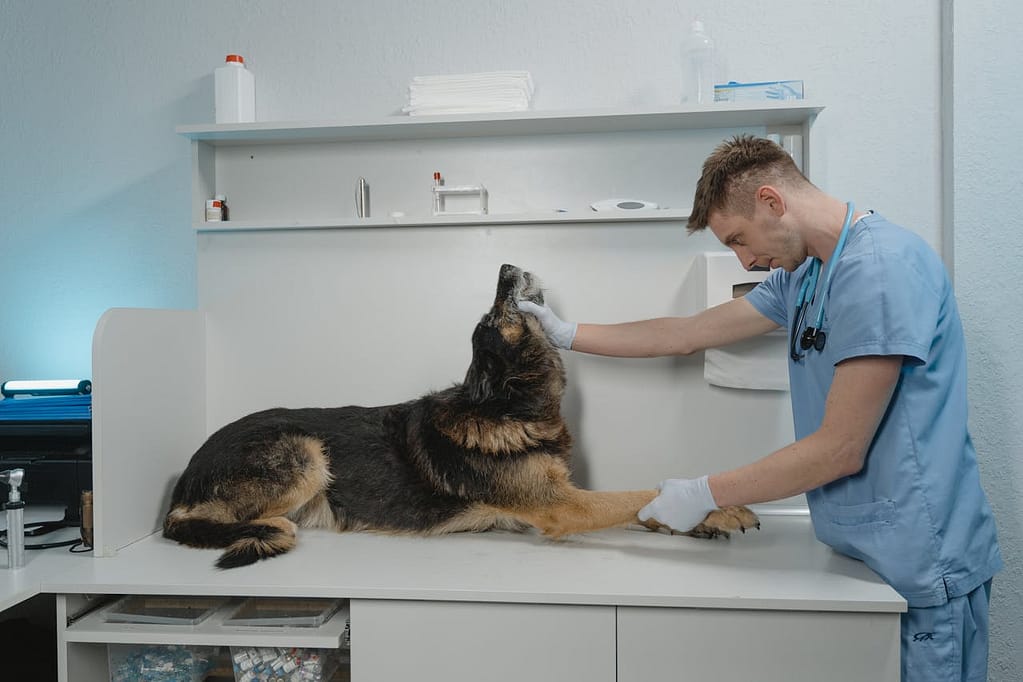
Signs and Symptoms of FCE
One moment your cat or dog is running, playing or simply walking across the yard. Minutes later they may be unable to stand, dragging one or more legs, or lying confused on the ground. The suddenness of these changes is frightening, and it’s natural to fear the worst.
Although FCE is considered a neurological emergency that requires immediate veterinary assessment, there is one reassuring fact worth remembering: many cats and dogs go on to make remarkable recoveries with appropriate veterinary care, rehabilitation and dedicated home support.
Understanding the signs and symptoms of FCE can help you recognise when something is seriously wrong, seek veterinary attention quickly and begin your pet’s recovery journey with greater confidence.
While every dog is different, there are several hallmark signs that veterinarians commonly see in dogs experiencing a spinal stroke. This guide explains what those signs look like, why they happen, and when they require emergency treatment.
FCEtalk Reminder
A sudden inability to walk is always an emergency.
Never assume it is simply old age, arthritis or a pulled muscle. Your veterinarian is the only person who can accurately diagnose the underlying cause.
What Happens During an FCE?
Before looking at the symptoms, it helps to understand what is happening inside your dog’s body.
An FCE occurs when a tiny piece of fibrocartilage—material normally found inside an intervertebral disc—enters one of the blood vessels supplying the spinal cord. The blockage reduces blood flow to part of the spinal cord, depriving nerve tissue of oxygen and nutrients.
The result is similar in principle to a stroke affecting the brain, except the damage occurs within the spinal cord.
Because the spinal cord carries messages between the brain and the body, interrupting these signals can suddenly affect:
- movement
- balance
- coordination
- bladder control
- sensation
- limb strength
Exactly which functions are affected depends on where the spinal cord injury occurs.
At a Glance: Common Signs of FCE
| Symptom | Common in FCE? | Requires Emergency Veterinary Care? |
|---|---|---|
| Sudden collapse | ✅ Very common | ✅ Yes |
| Difficulty standing | ✅ Very common | ✅ Yes |
| Weakness in one or more legs | ✅ Very common | ✅ Yes |
| Paralysis | ✅ Common | ✅ Yes |
| Dragging paws | ✅ Common | ✅ Yes |
| Loss of bladder control | Sometimes | ✅ Yes |
| Crying in pain | Usually only initially | ✅ Yes |
| Progressive worsening over days | Usually No | Needs veterinary assessment |
Sudden Collapse
One of the defining characteristics of FCE is how suddenly it appears.
Many owners describe their dog as completely normal only moments beforehand.
You might be playing fetch, walking around the house or heading outside when your dog suddenly:
- stumbles
- collapses
- cries out briefly
- struggles to stand
- drags one or more legs
- sits down unexpectedly
- appears confused by what has happened
Because the event occurs so quickly, families often suspect a broken bone, poisoning or seizure.
In reality, these dramatic changes are often caused by the spinal cord suddenly losing blood supply.
Unlike many spinal diseases, FCE generally reaches its maximum severity within the first several hours.
This rapid onset is one reason veterinarians consider it such an important diagnostic clue.
Some dogs can still walk, but with obvious weakness or poor coordination. Others lose the ability to stand almost immediately.
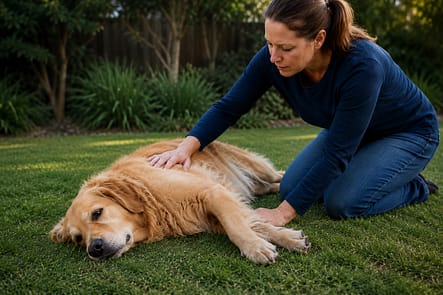
What You May Notice
Depending on where the spinal cord is affected, your dog may:
- fall onto one side
- repeatedly try to stand but fail
- wobble dramatically
- walk with crossed legs
- drag their paws
- stand briefly before collapsing again
Why Does Collapse Happen?
The spinal cord functions like the body’s electrical highway.
When nerve signals can no longer travel efficiently through an injured section of the spinal cord, muscles stop receiving clear instructions from the brain.
The result may be:
- weakness
- loss of balance
- loss of coordination
- complete inability to move certain limbs
Importantly, your dog’s muscles themselves are usually healthy—the problem lies in the communication between the brain and those muscles.
FCEtalk Tip
If your dog suddenly collapses, keep them as still as possible while arranging immediate veterinary care. Avoid encouraging them to walk if they cannot safely support themselves, as unnecessary movement may increase the risk of secondary injury.
Weakness Versus Paralysis
One of the biggest misconceptions surrounding FCE is that every affected dog becomes completely paralysed.
In reality, the severity varies enormously.
Some dogs experience only mild weakness, while others temporarily lose movement in two or even all four limbs.
Understanding this difference helps explain why recovery also varies between dogs.
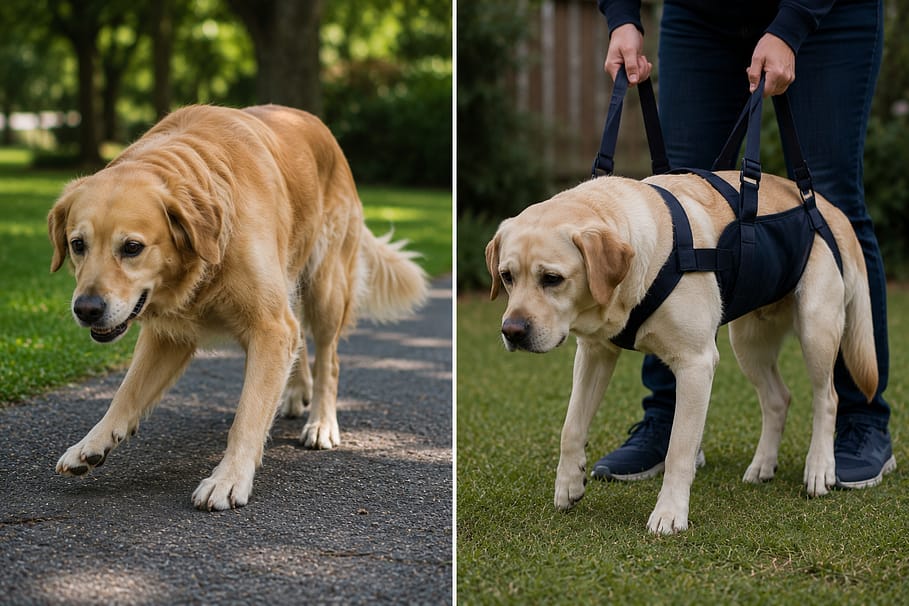
“Comparison of weakness (Paresis) on the left: Dog walking with a mild wobble and slight paw knuckling vs Right: Dog supported in a full-body harness unable to bear weight Paralysis (Plegia)
Weakness (Paresis)
Weakness means your dog can still move their limbs but lacks normal strength.
You may notice your dog:
- walking slowly
- stumbling
- knuckling over on their paws
- slipping frequently
- crossing their legs
- swaying while standing
- tiring quickly
Many dogs with weakness can still take steps, although those steps may appear clumsy or exaggerated.
Because the nerves are still transmitting some signals, these dogs often have an excellent rehabilitation potential.
Paralysis (Plegia)
Paralysis means voluntary movement has been lost.
Depending on the injury location, your dog may be unable to move:
- one leg
- both back legs
- one side of the body
- all four limbs
This can be extremely distressing to witness.
However, paralysis immediately after FCE does not automatically mean permanent disability.
The spinal cord often begins forming new neural pathways during rehabilitation, allowing many dogs to regain movement gradually over weeks or months.
How Veterinarians Assess Severity
Your veterinarian will perform a neurological examination that may include assessing:
- conscious movement
- muscle tone
- reflexes
- paw placement
- limb strength
- pain sensation
- coordination
These findings help determine:
- where the spinal cord injury is located
- how severe the injury appears
- whether other conditions are more likely
- what additional testing may be needed
In some cases, advanced imaging such as an MRI may be recommended to help distinguish FCE from conditions such as intervertebral disc disease (IVDD), spinal tumours or inflammatory disorders.
Can Weakness Become Paralysis?
During the first few hours after an FCE, neurological signs may change as the spinal cord responds to the injury.
Some dogs initially appear weak before becoming more severely affected.
Once the condition stabilises, however, FCE generally does not continue worsening over several days, unlike some other spinal diseases.
If your dog’s neurological signs continue deteriorating significantly after the initial event, your veterinarian may investigate other possible diagnoses.
Loss of Bladder Control
One of the most emotionally challenging symptoms for families is discovering that their dog can no longer urinate normally.
Many owners are unprepared for this aspect of FCE recovery.
Bladder problems are not present in every dog, but they are common when the spinal cord injury affects the nerves controlling the urinary system.
Why Bladder Problems Occur
Normal urination requires precise communication between:
- the brain
- the spinal cord
- the bladder muscles
- the urethral sphincter
When these nerve pathways are interrupted, your dog may lose the ability to empty their bladder voluntarily.
Instead, urine may:
- remain trapped inside the bladder
- leak unexpectedly
- dribble continuously
- overflow when the bladder becomes too full
This isn’t a behavioural issue or a sign that your dog has forgotten toilet training. It is a neurological consequence of the spinal cord injury.
Signs Your Dog May Have Bladder Dysfunction
Watch for:
- straining without producing urine
- frequent unsuccessful attempts to urinate
- urine leaking while lying down
- a swollen or firm abdomen
- wet bedding
- unusually small amounts of urine
- discomfort when attempting to toilet
Some dogs also lose normal bowel control during the early stages of recovery.
FCEtalk Care Note
Bladder management is one of the most important parts of early FCE care. Your veterinary team will determine whether your dog needs bladder expression, temporary catheterisation or close monitoring. Proper management reduces the risk of bladder overdistension and urinary tract infections while supporting your dog’s comfort and recovery.
Why Prompt Veterinary Care Matters
An overfilled bladder can quickly become painful and may increase the risk of complications if left unmanaged.
Early veterinary assessment allows your team to:
- determine whether your dog is emptying their bladder adequately
- teach you safe bladder management techniques if required
- monitor for urinary tract infections
- reduce the risk of long-term complications
- support your dog’s comfort during recovery
Although bladder care can feel overwhelming at first, many families become confident with practice and guidance. For dogs whose bladder function is temporarily affected by FCE, careful management is often an important stepping stone on the road to recovery.
Related Articles:
- Bringing Your Dog Home After FCEBring your dog home after FCE with confidence using practical advice on preparation, recovery, equipment, and supporting every step of healing.
- How Vets Diagnose FCE (Fibrocartilaginous Embolism)Understanding how veterinarians diagnose FCE can reduce uncertainty, explain each test, and help you feel more confident throughout your dog’s recovery journey.
- Dog Crates and Playpens for FCE recoveryIf your vet has recommended that they need a safe, cozy space to relax, recovery crates can be helpful in the right circumstance.
- The Best Playpens for FCE recovery in 2026If you’re searching for a dog crate that looks more like beautiful furniture than traditional pet equipment, you’re not alone.
- The Best Dog Crates for FCE recovery in 2026If you’re searching for a dog crate that looks more like beautiful furniture than traditional pet equipment, you’re not alone.
The information on FCEtalk is for educational purposes, uses the assistance of AI and is not a substitute for professional veterinary advice. Always consult your veterinarian about your pet’s health and recovery. Where clearly identified as professional content, it is still intended to support – not replace – your own veterinary team’s care.
Disclosure: Our website contains affiliate links. If you purchase through these links, FCEtalk may earn a small commission at no additional cost to you. This helps support our free educational resources and community.

Learn More About FCE
At FCE talk, we explore everything you need to know about Fibrocartilaginous Embolism (FCE) in dogs,
including symptoms, diagnosis, treatment, and recovery.