



Best Non-Slip Paw Shoes in 2026
After an FCE many dogs need protection for their paws. Here’s our roundup of the best available in 2026
A note about our site:
Where possible, FCEtalk uses minimal images for easier printing
helping you create clear, practical reference guides to support your pet’s recovery journey.
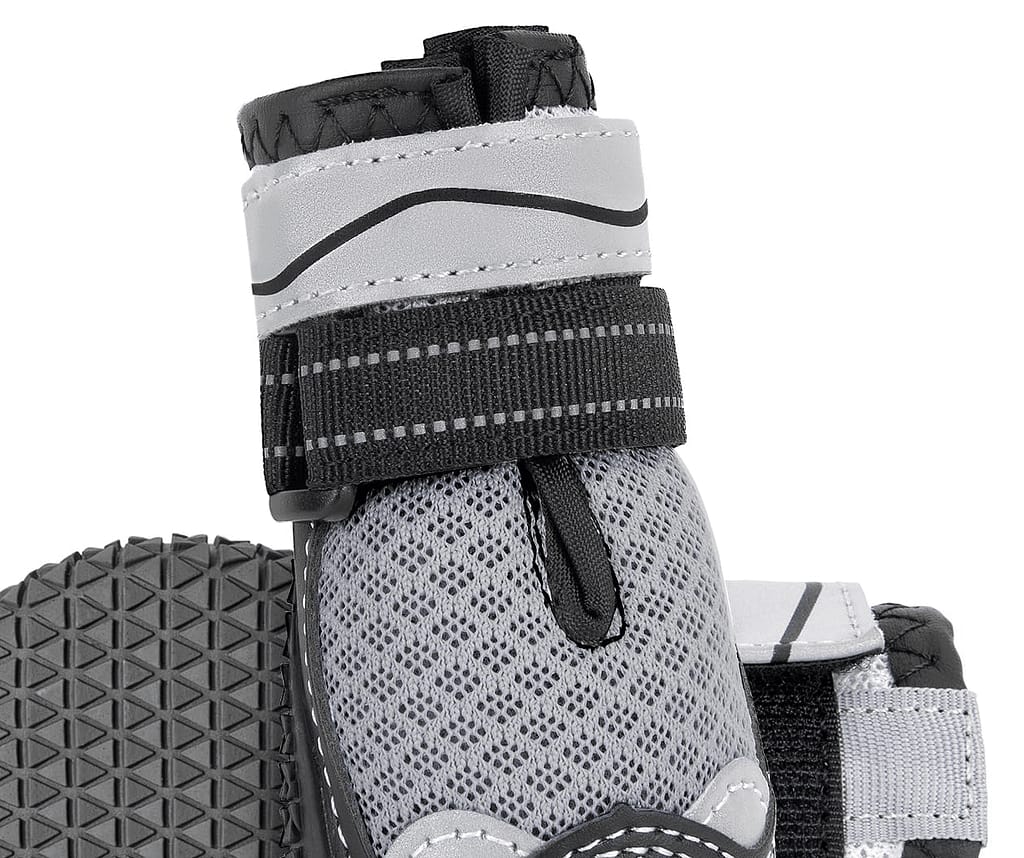
Best Non-Slip Paw Shoes to Support Dogs After FCE
After a spinal stroke, also known as a fibrocartilaginous embolism (FCE), your dog may experience weakness, reduced coordination, paw knuckling or difficulty maintaining traction. Even familiar surfaces such as polished timber, tiles and laminate flooring can suddenly feel challenging.
Non-slip paw shoes, boots or socks may help some dogs find better grip while protecting paws affected by dragging or knuckling.
Veterinary care and an appropriate rehabilitation program remain central to recovery, but small changes at home can also make movement safer and more comfortable. Non-slip paw shoes, boots or socks may help some dogs find better grip while protecting paws affected by dragging or knuckling.
Not every dog recovering from FCE will need footwear. Some dogs feel more stable with their paws uncovered, particularly when non-slip runners or rehabilitation mats are already in place. Others may benefit from carefully fitted paw protection during assisted walking, rehabilitation exercises or short outdoor trips.
Your veterinarian or canine rehabilitation professional can help you decide whether paw shoes are suitable for your dog’s particular movement pattern.
Why paw protection may help after FCE
FCE can affect each dog differently. Depending on the location and severity of the spinal cord injury, you may notice:
- Weakness in one or more limbs
- Reduced balance or coordination
- Paw knuckling
- Scuffing of the nails
- Dragging of the top of the paw
- Difficulty gaining traction
- Uneven weight distribution
- Increased fatigue when walking
Non-slip footwear cannot correct the neurological effects of FCE, but it may provide practical support. A suitable product can improve contact with slippery surfaces and create a barrier between the paw and the ground.
This protection can be especially valuable when paw dragging causes worn nails, grazed skin or fur loss.
Footwear must still be introduced carefully. Heavy, loose or poorly fitted boots may alter your dog’s gait, make paw placement more difficult or create a tripping risk. Check your dog’s movement and paws regularly, and discontinue use if the product causes discomfort, rubbing or increased instability.
Ratings reflect our experience and assessment of each product’s possible usefulness during FCE recovery. Every dog’s needs, gait and tolerance for footwear will be different.
Quick Summary for FCE Dog Owners
🏆 Best Indoor Option: Velmoriah Non-Slip Dog Socks
Ideal for dogs recovering from FCE who struggle on timber, tile, or laminate flooring. The double-sided grips can provide additional traction on timber, tile and laminate flooring, even if the socks rotate slightly during movement.
🏆 Best Budget-Friendly Choice: AutoWT Dog Boots
A practical choice for occasional outdoor paw protection, including hot surfaces, rough ground and areas containing small stones or debris. Provides solid traction and paw protection for dogs without the higher price tag of premium rehabilitation boots.
🏆 Best for Senior FCE Survivors: Velmoriah Anti-Slip Dog Socks
Lightweight and cushioned, these socks may suit older dogs experiencing mild residual weakness or reduced confidence on hard floors.
🏆 Best for Paw Dragging & Knuckling: SlowTon Breathable Dog Boots
Excellent for rehabilitation walks, physiotherapy exercises, and protecting paws from dragging. The durable toe protection and secure fit help reduce abrasions and nail damage caused by dragging paws during recovery.
| Product | Best For | Indoor Traction | Paw Dragging Protection | Comfort | Ease of Use | Overall FCE Recovery Rating |
|---|---|---|---|---|---|---|
| Velmoriah Non-Slip Dog Socks | Indoor rehabilitation and hardwood floors | ★★★★★ | ★★★☆☆ | ★★★★★ | ★★★★☆ | ★★★★☆ |
| AutoWT Dog Boots | Paw protection on hot pavement and rough terrain | ★★★★☆ | ★★★★☆ | ★★★★☆ | ★★★★☆ | ★★★★☆ |
| Velmoriah Anti-Slip Dog Socks | Senior dogs and mild FCE mobility issues | ★★★★★ | ★★★☆☆ | ★★★★★ | ★★★★★ | ★★★★☆ |
| SlowTon Breathable Dog Boots | Dogs with moderate to severe mobility challenges | ★★★★★ | ★★★★★ | ★★★★☆ | ★★★★☆ | ★★★★★ |
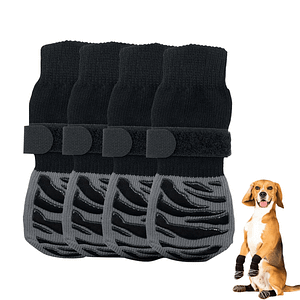
These socks are designed to improve traction with a lightweight layer of paw protection. Their double-sided grip is particularly useful as they remain in contact with the floor if a sock rotates.
Pros
- Double-sided silicone grips support traction on smooth floors
- Breathable cotton construction helps reduce overheating
- Included cohesive wraps can help keep the socks in place
- Lightweight design may be easier for some recovering dogs to tolerate
- Machine washable for easier everyday care
Cons
- The socks may slip off without additional securing wraps
- Correct sizing requires careful paw measurement
- Some dogs may repeatedly try to remove them
- They offer less protection from significant paw dragging than structured boots
We tested the Velmoriah Non-Slip Dog Socks on Flynn and noticed an improvement in his traction on our hardwood floors. The silicone grip dots on both sides were helpful because he could maintain some grip even when a sock moved slightly around his paw.
The included cohesive wraps helped keep the socks secure. Without them, the socks tended to work loose during normal movement. Any wrap must be applied with great care, however. It should never restrict circulation or place pressure around the limb. Check the paw frequently for swelling, temperature changes, redness or discomfort.
The breathable cotton remained comfortable during supervised use, and the Velmoriah Non-Slip Dog Socks were easy to wash after dusty or muddy outings. They breathed well enough that Flynn’s paws didn’t get sweaty or uncomfortable. For dogs experiencing mild knuckling or scuffing, the fabric may provide a protective layer. Dogs with persistent or forceful paw dragging may need a more durable boot with reinforced toe protection.
AutoWT Dog Boots
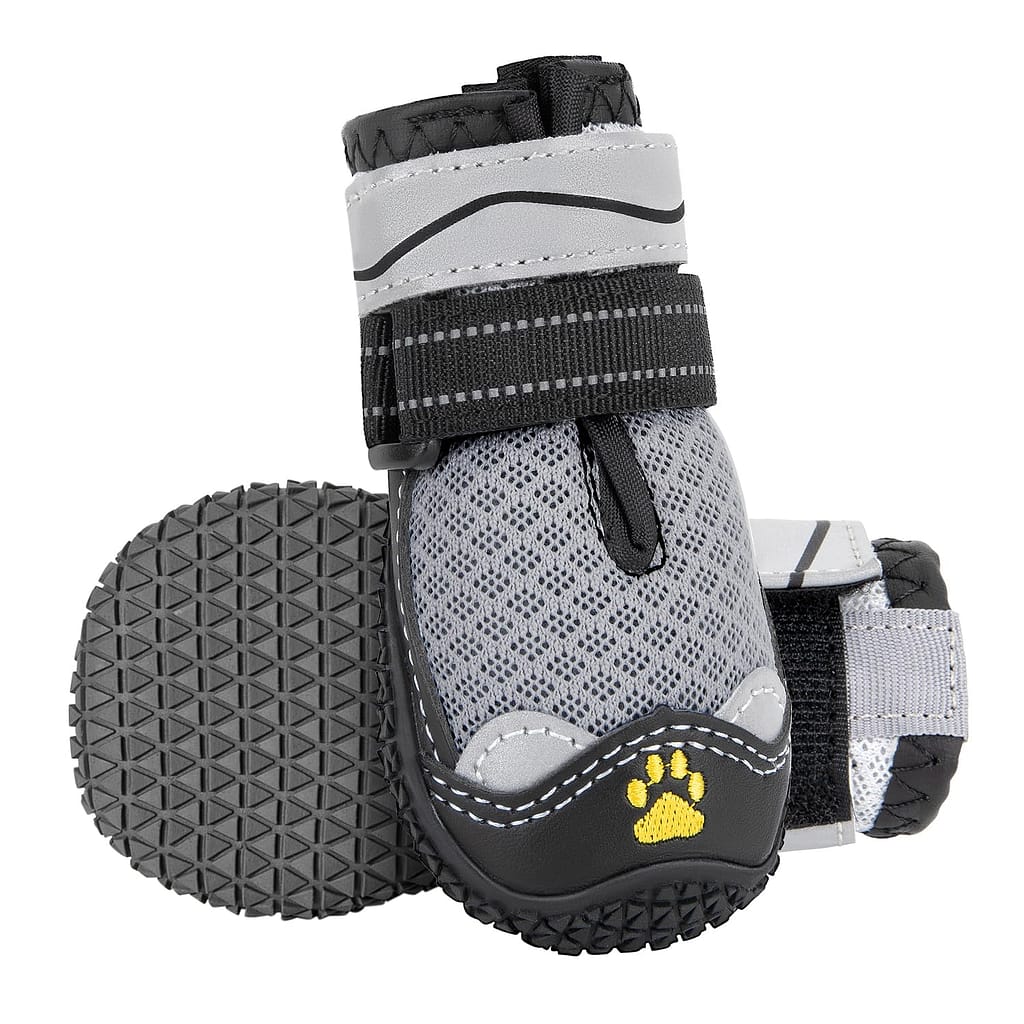
These boots combine breathable uppers with rubber soles and adjustable straps. They may be useful when your dog needs additional protection on warm pavement, rough ground or outdoor surfaces containing sharp debris.
Pros
- Rubber soles provide traction on indoor and outdoor surfaces
- Reflective strips improve visibility in low-light conditions
- Two adjustable straps help create a more secure fit
- Wide openings make the boots relatively easy to put on
- Breathable material allows airflow around the paws
Cons
- Only two boots come in each package instead of four, requiring multiple purchases for a full set
- The boots can slip off despite tight fastening, especially during extended wear
- They may not withstand heavy dragging or extremely rough use over time
We used the AutoWT Dog Boots on Flynn during warmer weather and while walking through the paddock. The soles helped protect his paws from warm ground, small stones and sharp debris, while the mesh upper allowed air to circulate. The wide opening made the boots easier to fit than some narrower designs. Each strap can be adjusted independently, which helped us secure the boots around Flynn’s lower legs.
Flynn adapted to walking in them quickly on various surfaces, and although they generally provided good traction, we noticed the AutoWT Dog Boots occasionally twisted or loosened during longer periods of use. This is particularly important to note during FCE recovery because a displaced boot may interfere with an already unsteady gait.
However, the biggest surprise was discovering only two boots in the package, not a complete set of four.
Velmoriah Anti-Slip Dog Socks
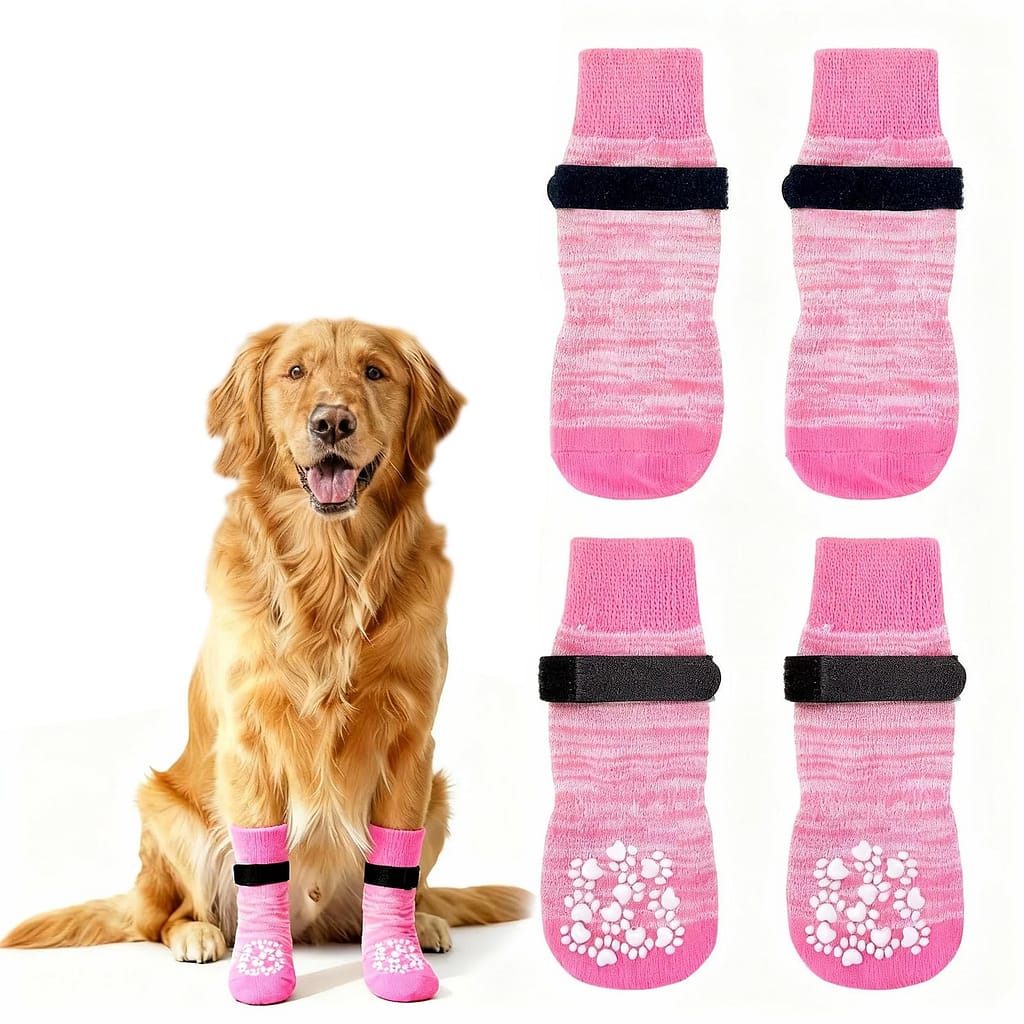
Lightweight, double-grip socks are an option for dogs who lack confidence or traction on hard indoor floors. They may be especially suitable for senior FCE survivors living with mild residual weakness.
Pros
- Double-sided grips support traction on timber and tile
- Elastic cuffs help reduce slipping and rotation
- Cushioned fabric provides comfort on hard surfaces
- Lightweight design may reduce fatigue
- Four-sock pack provides a spare set during washing
Cons
- The socks may slip from dogs with certain paw or leg shapes
- They provide limited protection from heavy paw dragging
- Thick fabric may feel unfamiliar to a dog with reduced coordination
- Some dogs need time to become comfortable wearing them
We tested the Velmoriah Anti-Slip Dog Socks on a senior dog with mobility issues after an FCE, and the difference in confidence was noticeable right away. The dual-grip design actually makes contact with the floor instead of just providing token texture.
As with many paw products, there was an adjustment period. The dog initially lifted the paws unusually high and walked even more awkwardly, especially considering his gait after his Spinal Stroke. This response is common when dogs first encounter footwear, but it is especially important to supervise a dog whose coordination is already affected.
After several short introductions, the Velmoriah Anti-Slip Dog Socks became more familiar. They also held up well through repeated washing without a noticeable reduction in grip.
For many dogs, socks are best introduced one or two at a time during brief, calm sessions. If your dog becomes less stable rather than more secure, remove them and discuss other traction options with your rehabilitation professional.
SlowTon Breathable Dog Boots
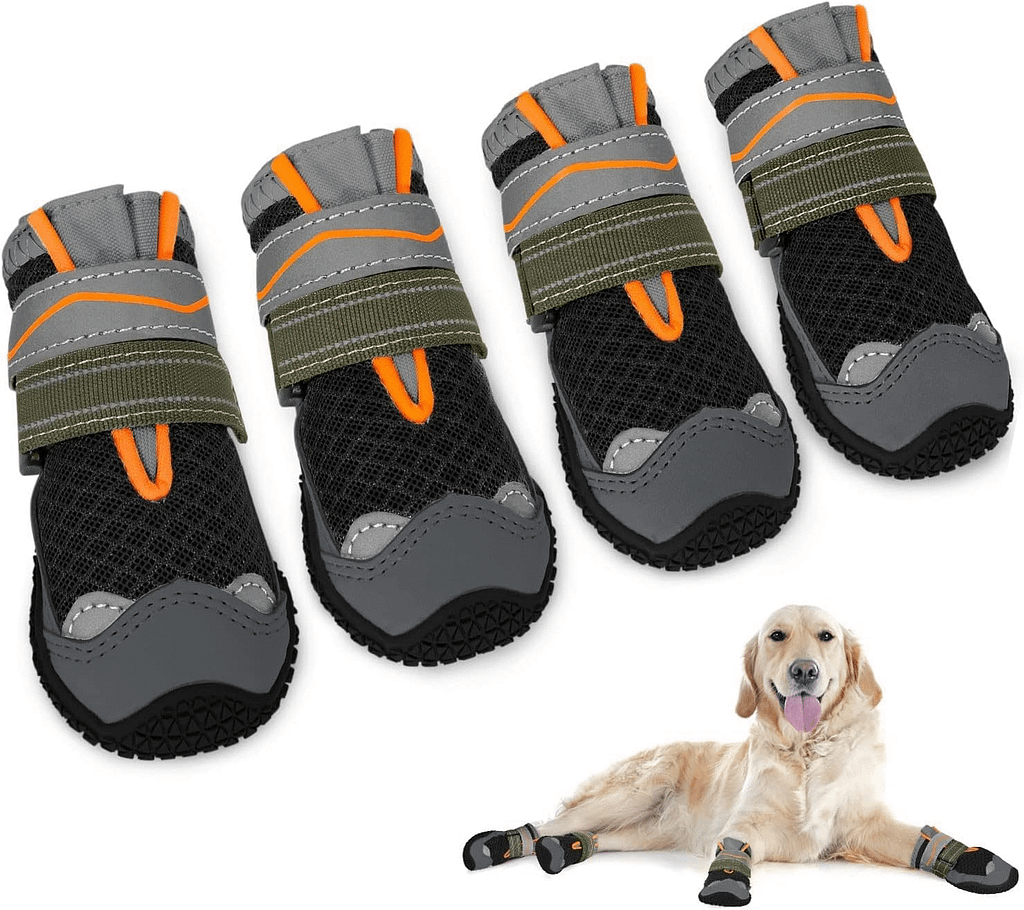
SlowTon Breathable Dog Boots provide a more structured option for dogs experiencing paw dragging, knuckling or moderate mobility difficulties. Their rubber soles and reinforced toe areas offer more protection than lightweight socks.
Pros
- Rubber soles provide grip on smooth indoor surfaces
- Reinforced toe areas help protect paws affected by dragging
- Double adjustable straps support a secure fit
- Breathable mesh helps limit heat and moisture
- Wide openings make the boots easier to put on
- Reflective strips improve visibility in low light
Cons
- Careful measurement is essential for a safe fit
- Straps must be adjusted correctly to prevent movement
- Some dogs initially walk awkwardly or resist the boots
- They may not remain comfortable during extended wear
- Added weight may not suit every dog’s gait
We have used the SlowTon Breathable Dog Boots with Flynn primarily for outdoor movement and paddock exercise. The breathable construction helped keep his paws comfortable, while the rubber soles provided additional grip on tile and hardwood flooring.
Getting the straps adjusted correctly took a few tries initially. Once we figured out the right tightness, the boots stayed put through walks and even some light running. Flynn did the typical awkward high-stepping response seen in many dogs wearing boots for the first time. His movement became more natural as he adjusted, although his FCE-related asymmetrical gait remained.
The waterproof toe section protects against puddles and damp grass. We appreciate that the SlowTon Breathable Dog Boots are lightweight enough that Flynn doesn’t seem burdened by them once acclimatised. They’ve prevented paw injuries on rough terrain and provided the grip needed on slick surfaces. Flynn does stuggle with keeping them on for longer periods, so they are probably not suitable as a paw licking preventative.
Choosing paw shoes for a dog recovering from FCE
Measure every paw
Your dog’s front and back paws may not be identical in size. FCE-related weakness can also change how a paw spreads when bearing weight.
Measure each paw while your dog is safely supported and placing weight through the limb, if they can do so comfortably. Follow the individual manufacturer’s sizing guide rather than relying only on breed or body weight.
Consider your dog’s movement pattern
The best product depends on the difficulty you are trying to address.
- Mild slipping indoors may respond well to non-slip socks.
- Occasional outdoor protection may require lightweight boots.
- Paw dragging may need reinforced toe protection.
- Significant instability may be better managed initially with floor runners, a support harness and professional rehabilitation guidance.
Look for a secure but comfortable fit
Footwear should remain in place without restricting circulation. A boot that is too loose may twist or become a tripping hazard, while one that is too tight may cause pressure, swelling or discomfort.
Remove the footwear regularly and inspect the entire paw, including between the toes and around the fastening points.
Choose breathable materials
Heat and moisture can build up inside socks and boots. Breathable materials are particularly important during warm Australian weather and for dogs wearing footwear during rehabilitation exercises. Never leave wet footwear on your dog.
The materials used in construction directly affect durability and comfort. We want to look for:
Durable stitching that withstands daily wear
Breathable fabrics that prevent overheating
Flexible soles that allow natural paw movement
Water-resistant materials for wet conditions
Match the sole to the surface
The bottom of the shoe determines traction and protection. We should examine the tread pattern and grip technology. Deeper grooves typically provide better traction on slippery surfaces. The sole should also be thick enough to protect against hot pavement or rough terrain.
A soft, flexible sole often provides better contact with smooth indoor flooring. A thicker rubber sole may be more suitable for hot pavement, gravel or rough outdoor ground.
The sole should provide grip while remaining light enough for your dog to lift and place the paw safely.
Introduce footwear gradually
Allow your dog to sniff the product before gently placing it on one paw. Keep early sessions brief and positive.
Some high-stepping is common initially, but footwear should not cause persistent stumbling, distress or greater difficulty placing the paws. Stop if your dog appears less stable.
Ease of Cleaning
Paw shoes get dirty quickly, so maintenance matters. We recommend checking if the shoes are machine washable or require hand cleaning. Quick-drying materials save time between uses.
Important safety guidance
Non-slip shoes and socks should support your dog’s recovery rather than replace veterinary care, physiotherapy or changes to the home environment. Check your dog’s paws during and after every use for:
- Redness or rubbing
- Swelling
- Skin grazes
- Worn nails
- Moisture between the toes
- Pressure marks from straps
- Changes in paw temperature
- Increased licking or signs of discomfort
Seek veterinary advice if the paw is wounded, swollen, bleeding, unusually cold or hot, or appears infected. Do not place ordinary footwear over an open wound unless your veterinarian has recommended an appropriate dressing and protective covering.
Frequently Asked Questions
Non-slip dog shoes raise practical questions about fit, materials, and specific needs for different surfaces and activity levels. We’ve compiled answers to the most common concerns based on testing various booties across different breeds and situations.
Can non-slip paw shoes help a dog recovering from FCE?
Non-slip paw shoes may help dogs experiencing weakness, poor coordination or reduced traction after FCE. They cannot repair the spinal cord injury, but they may provide greater stability and confidence on slippery surfaces. Ask your veterinarian or rehabilitation professional whether footwear is appropriate for your dog’s movement pattern.
Which paw shoes are best for an FCE dog on slippery floors?
Soft, flexible shoes or socks with non-slip grips generally work well on timber, tile and laminate floors. Choose footwear that allows your dog to place the paw naturally without adding unnecessary weight. Non-slip runners may be preferable if shoes make your dog less stable.
Can dog boots protect paws affected by knuckling after FCE?
Boots with reinforced toe areas can help protect the skin, fur and nails when a dog knuckles or drags a paw. However, boots only reduce surface damage—they do not correct the neurological cause. Persistent knuckling should be discussed with your veterinary or canine rehabilitation team.
Could wearing paw shoes interfere with FCE rehabilitation?
Poorly fitted, heavy or rigid footwear can make paw placement more difficult and may alter your dog’s gait. This is particularly important when coordination and proprioception have been affected by FCE. Watch your dog closely and remove the footwear if stumbling, dragging or instability increases.
How do I choose the correct size for my recovering dog?
Measure each paw at its widest point while your dog is safely supported and bearing weight, if possible. Front and back paws may require different sizes. The footwear should remain secure without restricting circulation, rubbing the skin or placing pressure on weakened limbs.
How should I introduce paw shoes after an FCE?
Begin with one shoe or sock during a short, calm and supervised session. Allow your dog time to adjust before adding more. Some initial high-stepping is normal, but stop if your dog becomes distressed, repeatedly falls or appears less coordinated.
Should an FCE dog wear paw shoes on all four paws?
Not necessarily. Some dogs need protection only on the limb affected by dragging, while others benefit from traction on two or four paws. Because FCE often causes uneven weakness, your veterinarian or rehabilitation professional can help determine the safest arrangement.
How long can my dog wear non-slip shoes during FCE recovery?
Use them for short, supervised periods unless your veterinarian recommends otherwise. Remove them regularly to allow the paws to breathe and to check for moisture, swelling, rubbing or pressure marks. They should not generally be left on overnight or while your dog is unattended.
Are paw shoes better than non-slip runners after FCE?
They serve different purposes. Runners create reliable traction throughout your dog’s main walking areas without changing how the paws feel. Shoes travel with your dog and may protect against dragging or rough surfaces. Many families use runners indoors and boots only for specific rehabilitation or outdoor activities.
Can my dog wear boots during FCE rehabilitation exercises?
Possibly, if your veterinarian or rehabilitation professional approves. Boots may improve grip or protect a dragging paw, but they may also reduce sensory feedback from the floor. Your therapist may prefer bare paws for some exercises and footwear for others.
When should I stop using paw shoes?
Stop using them if your dog becomes less stable, develops rubbing or swelling, shows discomfort, or repeatedly catches the boots against the floor. As strength and coordination improve, your dog may no longer need footwear. Review their use regularly with your rehabilitation team.
What should I do if my dog’s paw is already injured from dragging?
Arrange a veterinary assessment if you notice broken skin, bleeding, swelling, discharge or significant nail damage. Do not place ordinary footwear directly over an open injury unless your veterinarian has advised you how to dress and protect it safely.
Final thoughts
The right paw protection can make everyday movement feel safer for some dogs recovering from FCE. Non-slip socks may support indoor traction, while structured boots can help protect paws affected by dragging or outdoor hazards.
Footwear is only one part of a wider recovery environment. Non-slip runners, appropriate rehabilitation, careful supervision and a well-fitted support harness may be equally important.
Observe how your dog moves rather than judging a product only by how securely it stays on. If the footwear improves confidence without causing discomfort or altering movement negatively, it may become a valuable addition to your FCE recovery toolkit.
Every dog responds differently, and finding the right solution may take patience. Work with your veterinary team, celebrate the small gains and remember: you and your dog are not travelling this journey alone.
Related Articles:
- Bringing Your Dog Home After FCEBring your dog home after FCE with confidence using practical advice on preparation, recovery, equipment, and supporting every step of healing.
- How Vets Diagnose FCE (Fibrocartilaginous Embolism)Understanding how veterinarians diagnose FCE can reduce uncertainty, explain each test, and help you feel more confident throughout your dog’s recovery journey.
- Dog Crates and Playpens for FCE recoveryIf your vet has recommended that they need a safe, cozy space to relax, recovery crates can be helpful in the right circumstance.
- The Best Playpens for FCE recovery in 2026If you’re searching for a dog crate that looks more like beautiful furniture than traditional pet equipment, you’re not alone.
- The Best Dog Crates for FCE recovery in 2026If you’re searching for a dog crate that looks more like beautiful furniture than traditional pet equipment, you’re not alone.
The information on FCEtalk is for educational purposes, uses the assistance of AI and is not a substitute for professional veterinary advice. Always consult your veterinarian about your pet’s health and recovery. Where clearly identified as professional content, it is still intended to support – not replace – your own veterinary team’s care.
Disclosure: Our website contains affiliate links. If you purchase through these links, FCEtalk may earn a small commission at no additional cost to you. This helps support our free educational resources and community.

Learn More About FCE
At FCE talk, we explore everything you need to know about Fibrocartilaginous Embolism (FCE) in dogs,
including symptoms, diagnosis, treatment, and recovery.